If you don’t suddenly have Salt ‘N’ Pepa playing in your head, then you didn’t read that headline right.
Monday I’m in Love with MetaMask

Sunday night I went to bed with a bit of ETH in one wallet and a bit of SOL in the other. Hoping to grow my bag and trade some memecoins for profit this week. When I woke up Monday morning, however, my Metamask account greeted me with a grand total of $.01 ETH in my account.
“Not again?!” I thought, as I dug in to find out when my funds had left my wallet and where they’d gone. Sometime in the middle of the night, all but one penny of my Ethereum stash was taken by scammers. Has this happened to you? If it hasn’t, you’re either very lucky or very smart. And we can’t be both all the time. In 2022, hackers stole nearly $4B from cryptocurrency exchanges,
Scammers are everywhere in the crypto scene, but the place where they really shine is on social media. Here, bad actors can remain largely anonymous, the only signs of their intrusion being your empty wallet, a virtually untraceable burner wallet address, and the acute embarrassment of being fooled. Anyone who’s been following the blockchain for more than a week knows that these dudes have no boundaries when it comes to their tactics for talking you out of your crypto secrets. So, if you do get scammed, try not to feel too bad. The grifters certainly won’t waste any time feeling ashamed. If you learn your lesson and improve your security, then the net gain will likely be more than you lost.

As for me, I was scammed pretty severely when I began dabbling in crypto a few years ago. Of the scams discussed here, I went big and fell for the now infamous Pancake Swap Front Running Bot of 2022. What got me back then was that the dude showed his face in the video. I thought that a scammer would never show his face, but that is definitely not the case in the crypto world. In fact, the scammers are always quite proud of themselves and love to claim credit and brag about their spoils.
When I began working on this story, I knew that I would likely lose some money trying to get these scammers to show me what they’re working with. And it did cost me some. But hopefully now my mistakes will be ones you won’t have to make.
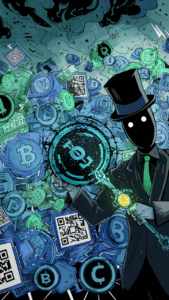
When it comes to scams, there are three common types being run through social networks right now: Bots, Giveaways and Airdrops. In all cases, you are being promised something for free. And we all know how that usually works out.
I have been keeping my crypto social action mainly on X because I find it to be less scammy than Telegram. Let’s put it this way: If X is an over-opinionated egotistical frat boy who thinks he knows everything, then telegram is that same frat boy after he’s graduated, gotten married, had kids, and is now trying to sell you life insurance (if you’re a female, then think of your prom queen/sorority girls who are now MLM moms 😉).
If you’re going to hang out on telegram, try to keep in mind that about 99% of the people you talk to on there would do anything for a quick buck. It’s largely anonymous and the overuse of emojis, GIFs, and memes in these groups can make things chaotic and confusing. Since so much legitimate financial business is being done via throwaway, anonymous social media accounts, it has become increasingly hard to spot the fraudsters and fakes. It can be hard to take some of these people seriously, despite their apparent financial knowledge and technical savvy. The truth is that, even though FluffBunny69HarryPotterGrrl might not have a clue about proper punctuation or capitalization rules, IRL she might be a crypto-gazillionaire.
That being said, let’s explore our first type of scam, the “You’ve Won an Arbitrage Bot!” scam.
The Bots
Just like almost any way of making money on the internet, cryptocurrency trading automation bots can be wildly profitable or the rocks that dash your dreams of independent wealth and/or the luxury of a self-managed work schedule. In the worldwide web’s wild west, crypto trading bots are the gunslinger lurking in the shadows who could just as soon swoop in and save the damsel in distress as be the cause of said distress. Before you fire up Visual Studio Code and follow some net-boy’s instructions, make sure you know what the code is actually doing.
Many of these bot scams start out on Twitter or Instagram, you get a DM announcing that you’ve won a free trial of their newest creation, sure to make you rich by tomorrow. They tempt you to move off of the social media site and over to Telegram. Here there is a roomful of people who will tell you that the bot is the very best bot that there ever was and that you will be very rich very soon if you use the bot.
Except you know it’s too good to be true. Don’t you?
A few weeks ago I “won” the pro version of a trading bot that promised huge returns on my investment. They sent me very detailed instructions on how to install the bot and make sure to fund it with at least .5 ETH.
They have a Twitter with several thousand followers, a website, a Telegram… must be legit, right?
Except you know it’s too good to be true. Don’t you?
If it feels like it might be a scam, it’s probably a scam. A lot of these new scams are very well executed; intricately designed to make it nearly impossible to tell that though you’re not talking to a trustworthy professional. The last scammers even sent me an activation key and the customer support asked for that key when I engaged to ask questions. They will use every method available to appear legitimate.
Everything seemed so legit, but the important thing to remember is that it is not. If someone asks you to fund something you’ve “won”, then you haven’t won anything. Walk away.
The Hardware Wallet Gas Fee
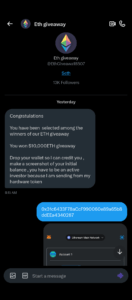
In this scenario, the scammer tells you that that you’ve won some insane amount of crypto, but in order to claim it you just need to pay the gas. As you can see in the screenshots, I’m not exaggerating when I say their promises are outlandish. But since there are a few REAL people giving money away in the crypto scene, these scammers get away with it.
Over the weekend, I was informed that I had been selected as the winner of a prize of $10,000 in ETH. I was, of course, overjoyed and immediately provided my information to receive me prize. I’m kidding – No I was not and no I did not! I actually messaged back and forth with my potential benefactor for quite some time. He assured me that if I just paid the $30 in gas to his wallet (which I checked after he sent me the address and did not have $10k of Ethereum in it), he would be able to send the funds from his hardware. While it might be true that gas is needed for these transactions, if you are supposedly winning a prize, you should not have to pay anything in advance to receive that prize.
As I got more skeptical, the scammer got increasingly desperate. Like that helicopter girlfriend, these dudes will hound you all day: “You can trust me!” “I would never take your money!” “Just give me a little bit of cash and I’ll give you everything!” Just as we should not fall for those women, we should not fall for these scammers.
Trading crypto is just like a relationship – If you think there might be red flags, there are definitely red flags. Get out while you still have your shirt!
The Airdrop Claim
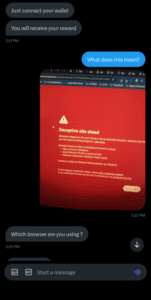
Much like the hardware wallet scam, the airdrop claim asks you to pay money to receive your reward. Many times this scam begins with an NFT dropped into your wallet just like you would receive in an official, legitimate airdrop. Pay careful attention to the link you are sent. If it doesn’t match the official airdrop link or if your browser warns you about the site’s trustworthiness, steer clear.
As you can see in the message screenshot on the right, I asked this particular scammer why he was sending me to a site that Chrome thought was suspicious. When he asked which browser I was using, I told him and then immediately tried the site in two other browsers. Both Edge and Brave flagged the site as malicious. This wasn’t just a case where the Web 2.0 browser didn’t recognize the legitimacy of a Web 3.0 site, as can sometimes happen, there is a real trust issue here.
When I proceeded to the site this became even more evident. It instructed me to connect my wallet and when I clicked the link it asked me to verify my secret passphrase. This is an immediate no-go. No one – not even the company managing the wallet software – will ask you for your secret passphrase. Never share it. If someone asks you for it or your Private Key, it is a sure sign that they cannot be trusted.
Protection is Key
While there is no such thing as actual safety and security in cryptocurrency, there are ways to mitigate the risks you are taking with your personal information and finances. Stay tuned for our upcoming series on the best ways to keep yourself protected from scammers, hackers, and all the other baddies just waiting for you to let your guard down. We will discuss burner wallets, cold hardware wallet solutions and even dive into the super-secure advantages of setting up a virtual machine.
Have you been scammed by these tactics or others? If so, tell me about it in the comments or an email Sam@uncomplicatingcrypto.org . Stay tuned for our upcoming in-depth report on how to keep your identity and valuable digital holdings safe from scammers, hackers and any other less-than-scrupulous netizens.